CapPilote — the cockpit
The part you see. A browser, your screens, your content, your schedule. Nothing to install on your computer, and the same interface on a phone.

The same people, the same product — two names that finally say what they do. CapPilote runs your screens from any browser, CapDisplay brings them to life. 614 screens live today.
VisualCom has been designing, installing and running digital signage for over ten years. ClicAndPublish was the name of its platform — one word covering both the software and the player sitting behind the screen, to the point where customers no longer knew which one they were talking about on the phone. The name has not gone away: it lent its initials to the two products that came out of it.


The part you see. A browser, your screens, your content, your schedule. Nothing to install on your computer, and the same interface on a phone.
What runs inside the screen, or in the small box behind it. It keeps your content locally: a network outage does not black out your shop window.
ClicAndPublish → CAP
The acronym did not come out of a branding agency — it was already there, inside the name. CAP stands for ClicAndPublish. What you bought has not changed hands, changed team, or changed address.
Anyone can sell digital signage. What follows comes out of ten years spent fixing real screens, on real internet lines, 17,000 km from anyone's head office.
Open a screen's page and watch it in real time, like a video. Not a snapshot every ten seconds: a smooth stream showing exactly what a customer is looking at right now.
The connection is established directly between the screen and your browser. Nothing goes through our servers — so no relay to delay the picture, and no video of your premises stored on our side.
On a site with several screens, the first one downloads the file from our servers; the others fetch it from their neighbours over the local network. Your internet line pays for the video once, not once per screen.
Measured on our own fleet: a 480 MB video pushed to 4 screens. 29% of the chunks came from the local network — 450 MB that never touched the site's line. All four screens up to date in 5 min 16 s.
Take control of an Android screen or a Windows machine straight from the browser: see the screen, click inside it, type on it. No TeamViewer, no third-party software to install or renew.
Reserved for VIP accounts, at €10 per month per seat. It requires a screen provisioned by us — that provisioning is what allows gestures to be simulated.
Blank page syndrome spares no one: faced with an empty layout, nobody knows where to start. So just write what you want to see — "the lunch menu on a dark background, three columns, my current prices, logo top right" — and the layout builds itself. You keep control of every element: it is a starting point, never a cage.
A printed poster says one thing, and only that thing, until somebody walks over and takes it down. A screen says what is needed, when it is needed, across twelve sites at once. The industry figures have been consistent for fifteen years.
We quote these three studies as they circulate in the trade; we have not reproduced them ourselves. Better still, run the sum that applies to you: what an A2 poster reprinted every week actually costs — printing, shipping, and the person who puts it up at each of your locations — against €42 per year per screen.
You do not need to buy a "digital signage display". You need a screen — the one in the lobby, the one in the waiting room, the one you already own — and something to give it a voice. There are two ways in, and the second one costs nothing at all.
€199 incl. tax, per unit
An HDMI stick roughly the size of a pack of chewing gum. It plugs in behind the screen and draws its power from the screen's own USB port: no extra wall socket to find, no power brick, not one more cable hanging down. The screen comes on, CapDisplay boots, your content appears.
€0 in extra hardware
Many professional displays — and a good share of recent televisions — already run Android. When that is the case, CapDisplay installs straight into the screen. No box, no HDMI cable, no second power supply: one mains lead for the whole thing, and nothing left to hide behind the display.
Either way the software is the same and the price is the same: €42 per screen per year, free forever for one user and a first screen. See the full price list.
614 screens across 137 sites, in New Caledonia and French Polynesia. This map is live: it refreshes every three hours, straight from our servers.
No customer name appears on this map, and positions are deliberately rounded to about 300 m: it shows a neighbourhood, never anyone's address. Each dot carries the number of screens at that site.
Six things that come up every single day with our customers. There are others, but these are the ones people ask for again.
Content is stored inside the screen. An internet outage does not leave you with a black window — it leaves you with yesterday's playlist, which is not the same thing at all.
A screen in Nouméa and a screen in Papeete are not on the same time. Your time slots are read in each screen's local time, not yours.
A film of up to 2 GB can be pushed straight to the screen without going through your media library or saturating your line.
You maintain a list of products and prices; the screen lays it out on its own and follows every change you make.
Neighbouring screens on the same network can play the same thing at the same time, with no visible drift between them.
Head office prepares, the stores publish. Each account only sees the screens and folders that concern it.
A few of our installations, written up in detail on the VisualCom site (in French).
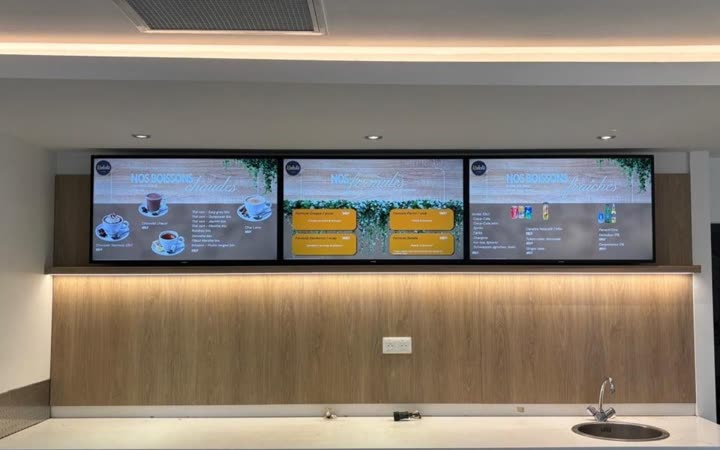
Three professional 43-inch screens for the counter's menu board, in the public hall of the international airport.
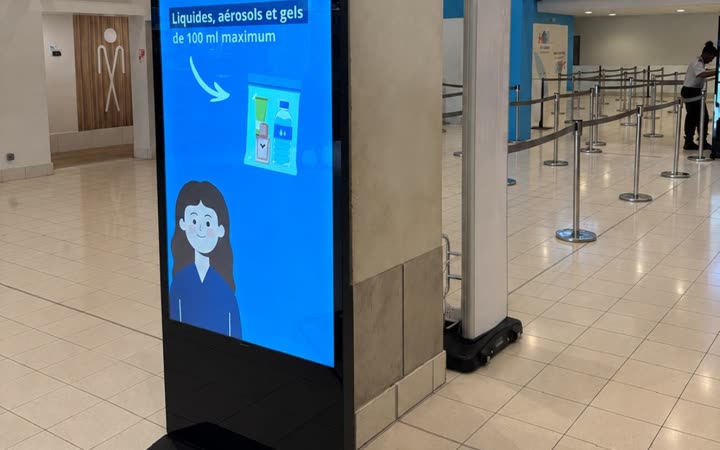
Two 65-inch totems to modernise the chamber of commerce's communication with passengers.
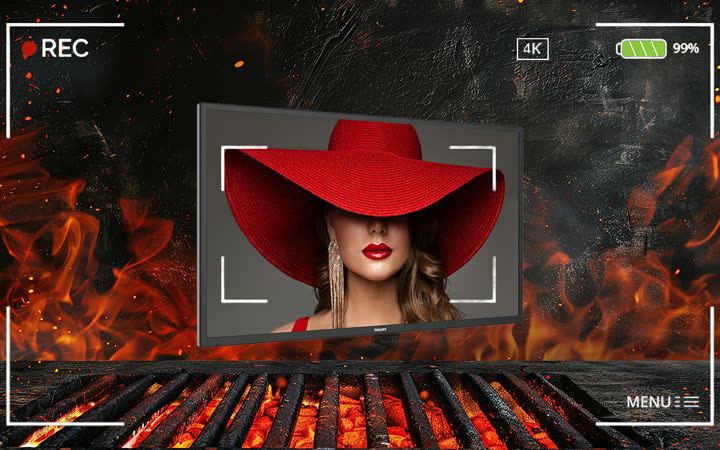
Professional screens in the dining room and at the counter, driven from a workspace dedicated to the brand.
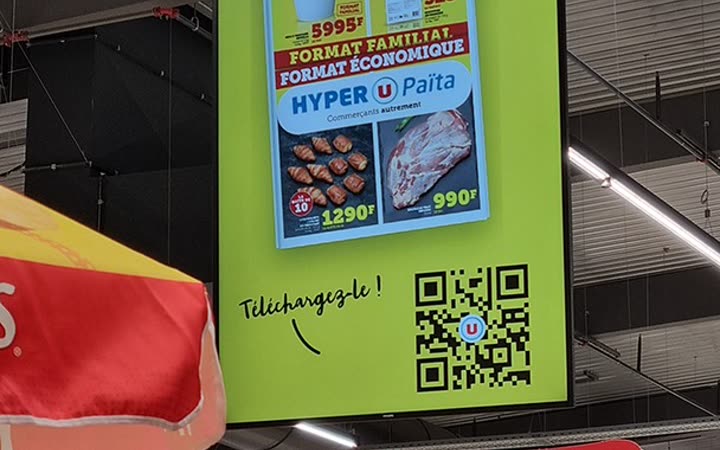
Advertising screens suspended over the aisles, above the shelves.
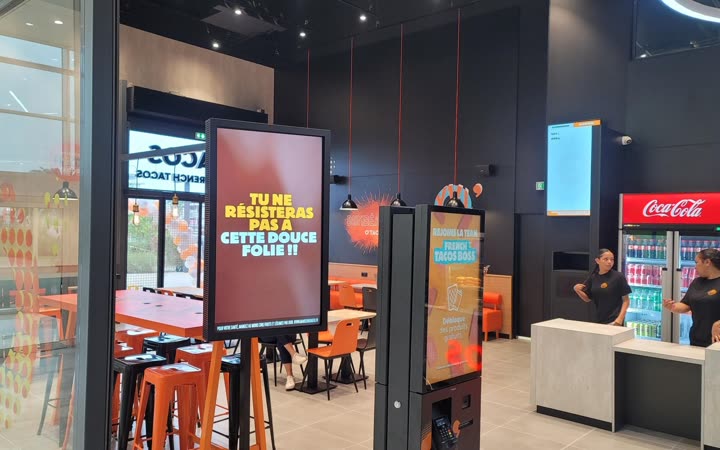
Seven monitors in portrait mode for the menu of the mall's new restaurant.
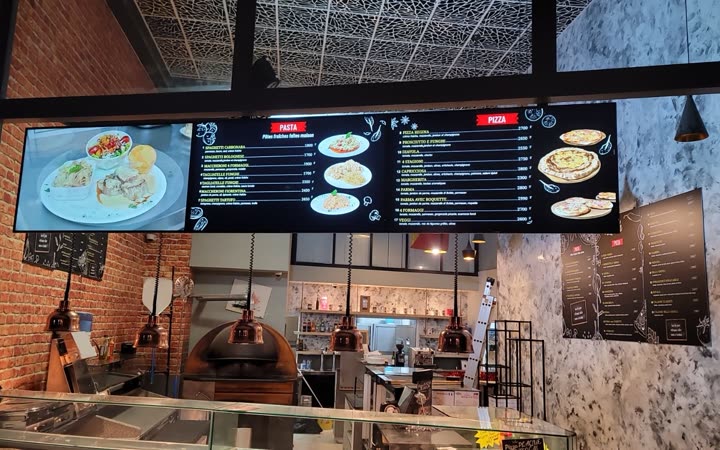
Three 55-inch screens at the entrance, giving a mouth-watering preview of what the chefs prepare on site.
More installations on visualcom.nc.
Monthly cost per screen, brought to the same unit, across the main solutions on the market. Prices are the ones each vendor publishes.
Price is not the whole story. The full table also compares what each one can actually do —
offline playback, remote control, local video, synchronised screens.
See the detailed comparison
One account, one screen, and you judge for yourself. Free forever for one user; fifteen days to try everything else. No card is asked for.